Why Wellness Culture Isn't Working for You

What I Learned From a Home Renovation About Stress, Wellbeing, and Sustainable Change
For decades, we've been told some version of the same story.
Get more sleep.
Eat healthier.
Exercise consistently.
Reduce stress.
Drink less.
Set better boundaries.
Practice gratitude.
Develop a growth mindset.
The advice isn't wrong.
In fact, most of it is supported by good science.
So why do so many intelligent, capable women continue to struggle to implement the very things they know would make them feel better?
Why do healthy habits start and stop?
Why does burnout return?
Why does stress continue to dominate our lives despite our best efforts to manage it?
Perhaps the problem isn't a lack of information.
Perhaps the problem is that wellness culture has been focused on the furnishings rather than the architecture.
The Renovation
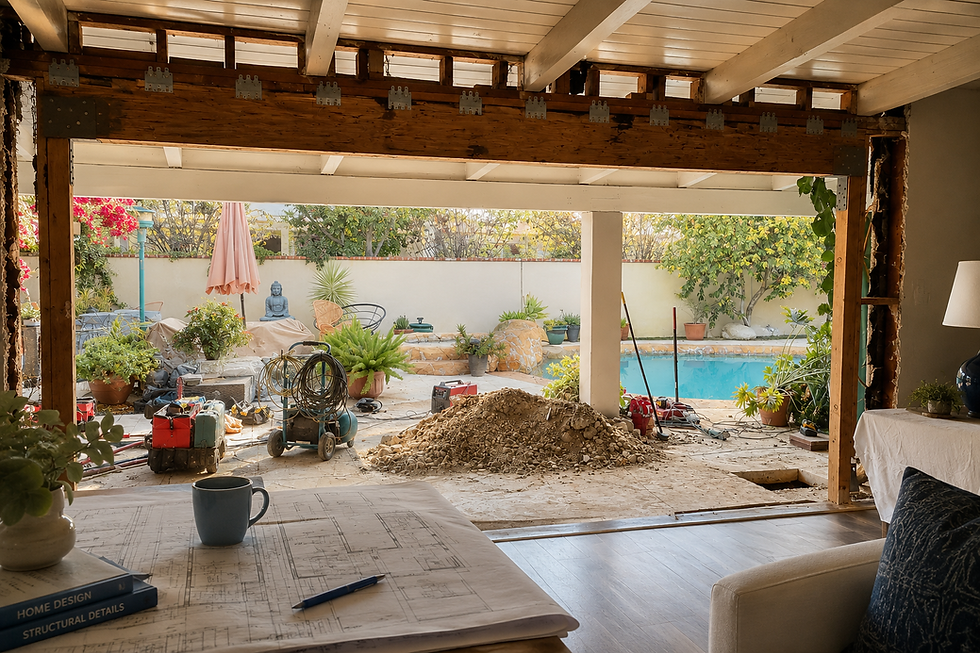
Several years ago, as part of a greater holistic home renovation, I decided to replace the sliding glass doors in my living room with larger, wider doors that would bring in more light and create a greater sense of openness.
At first, it seemed like a fairly straightforward renovation.
Until the contractor explained that it wasn't.
The opening couldn't simply be widened.
The support beam above the doors wasn't designed to carry the additional load.
Before the beautiful new doors could be installed, the structure itself needed to be reinforced.
What I thought would be a relatively simple home improvement project suddenly became a significant structural undertaking.
And an expensive one.
The additional engineering, permits, labor, and materials added nearly $15,000 to the budget.
What made the experience even more interesting was what happened next.
Once the wall was opened, the contractor discovered that the existing beam wasn't simply insufficient for the new doors.
It had never actually been up to code.
No one knew.
Because it had been hidden behind the wall for years.
The house looked fine from the outside.
The problem wasn't visible until the structure was exposed.
At the very same time, I was navigating one of the most significant transitions of my professional life.
I knew I needed to make a career pivot.
I could feel it.
Yet I was still trying to hold together a version of my life that no longer felt fully aligned.
Like many women, I focused on the symptoms.
I was meditating.
Practicing stress-management techniques.
Trying to regulate my nervous system.
Trying to create more calm.
And while those practices helped, they didn't fully resolve the tension I was experiencing.
Looking back, I understand why.
The stress wasn't simply coming from a lack of meditation.
It was coming from a deeper reality.
For a long time, I was able to compensate.
I could manage the stress.
Push through the exhaustion.
Continue performing at a high level.
Meditate.
Exercise.
Work on regulating my nervous system.
But eventually I reached a point where I could no longer ignore what was happening underneath.
The stress wasn't the problem.
The stress was providing information.
What I was experiencing wasn't a failure of mindset.
It was a signal that something deeper required attention.
The renovation didn't create the structural issue in my home.
It revealed it.
And eventually, just like a house with a strained support beam, the structure demanded attention.
Why Knowing Better Isn't Enough
Most women already know what supports their wellbeing.
We know sleep matters.
We know movement matters.
We know nourishment matters.
We know stress matters.
The issue is rarely information.
The issue is that many of the systems shaping daily life are reinforcing something else.
A woman can genuinely value health while living inside an architecture optimized for achievement.
She can value rest while operating from a value system that equates productivity with worth.
She can value connection while maintaining a schedule that leaves no room for meaningful relationships.
She can value wellbeing while consistently placing herself at the bottom of her own priority list.
The architecture is producing exactly the result it was designed to produce.
The Question Wellness Culture Often Misses
Most wellness programs ask:
"How do we add healthier habits?"
But perhaps the more important question is:
"What is my current architecture optimized for?"
Because if your architecture is optimized for proving, performing, people-pleasing, productivity, external validation, or constant achievement, then habits centered on restoration, recovery, nourishment, boundaries, and wellbeing will often struggle to take root.
Not because they are wrong.
Not because you lack discipline.
But because the architecture and the behavior are incongruent.
We are often taught that we can keep the same architecture that created the problem and simply layer healthier habits on top of it.
But lasting change rarely works that way.
When the foundation is shifting and the support beams are carrying more weight than they were designed to hold, beautiful furnishings may make the rooms feel more comfortable for a time.
Fresh paint may brighten the space.
A new sofa may make the room feel more inviting.
Decorative touches may even create the illusion that everything is fine.
But eventually the cracks begin to reappear.
Because the furnishings were never the problem.
The structure was.
And until the underlying architecture receives attention, no amount of decorating can fully restore the integrity of the home.
Eventually, the structure demands attention.
A Different Question
Perhaps before asking:
"How do I think differently?"
We should ask:
"Have I created a life that supports thinking differently?"
Because a woman who is chronically exhausted, overcommitted, disconnected from herself, operating from constant stress, and carrying the weight of everyone else's expectations may not need another affirmation.
She may need restoration.
Recovery.
Boundaries.
Connection.
Alignment.
She may need a different architecture.
The goal is not simply to think differently.
The goal is to create a life that makes different thinking possible.
Because alignment is not achieved when we know what matters.
Alignment is achieved when the life we've built has the capacity to support what matters.
Author's Reflection
As I continue developing the next phase of the ReinvenHER Blueprint, I've found myself increasingly interested in a question that many wellness conversations seem to overlook:
What if sustainable wellbeing isn't simply about changing behaviors?
What if it's about creating an architecture that supports those behaviors?
For years, my work through ReinvenHER has focused on helping women rediscover who they are beneath roles, expectations, and conditioning, and then intentionally design lives aligned with what matters most.
What has become increasingly clear to me is that insight and strategy alone are often not enough.
Many women know what matters.
Many women know what they need.
Many women have a vision for the life they want to create.
Yet they continue to struggle with exhaustion, overwhelm, burnout, disconnection, and the same recurring thought patterns.
Not because they lack awareness.
And often not because they lack discipline.
But because the architecture of their lives may not yet support what they are trying to create.
This realization has become the foundation of what I call Aligned Performance Life Architecture™.
A framework built around three interconnected layers:
Identity Architecture
Discover who you are.
Design Architecture
Design a life aligned with who you are.
Lifestyle Architecture
Create the conditions that sustainably support what you've designed.
Because transformation is not simply about discovering who you are.
And it's not simply about designing what comes next.
It's also about creating an architecture capable of supporting both.
Because ultimately, the goal is not simply to think differently.
The goal is to create a life that makes different thinking possible.


Comments